War in the Time of Love · Len Quimby
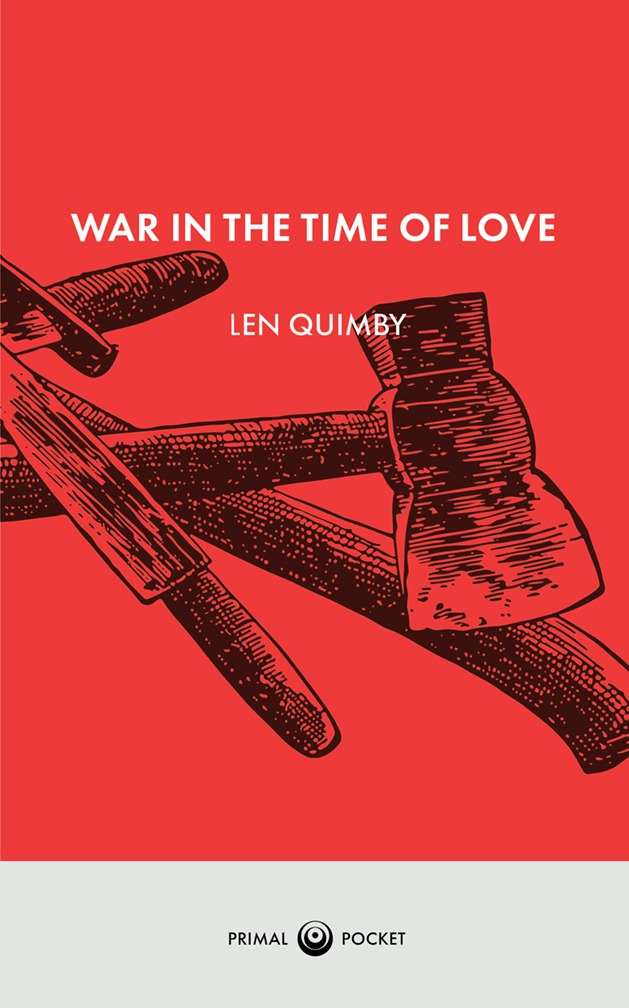
Forward-looking and trenchant, War in the Time of Love resists easy analysis. There are many ways to approach reality, but in these micro fictions – prose poems? – even if no one claims credit for the “the worst of the terror,” Quimby provides us with lived-in and transcendent experience which grows richer with every close examination.
About the Author
Len Quimby lives in a cabin over looking a kettle pond in eastern Penobscot County, Maine. He has worked construction, fishing, and most recently blueberry cultivation. War in the Time of Love is his first novella.
ISBN 978-1-971785-00-4
156 pages; paperback; 4.37″ x 7″
$12.00
read an excerpt
In his Travelogue of Nagasaki, on Sonny’s ship you could neither confirm nor deny the presence of nuclear weapons.
On a perfect planet, Ötzi and June finger the plastic flowers, the crosses, the paraphernalia of bikers and hippies, of families, mothers and fathers, classmates. Scattered around the sites are moldy cigarette packs, crushed beer cans, t-shirts, jeans, underwear, ballcaps with frayed bills resembling an upside U. Tacked to the nearby trees, telephone poles, or taped to crumbled and cauterized walls are weathered poems scribbled on yellow legal paper.
Who are these victims? How did they die?
The mother coming down the hill too fast into a grove of trees.
The biker chick head-on in the fog.
The drunk friend talking a turn too sharply.
The pick-up demolished by a semi-tractor trailer at the intersection of a farm road and a state highway.
The double suicide off a bridge. Did they hold hands going down? Did one instantly regret the jump, the other gleeful and relieved?
On this perfect planet, Ötzi and June drive the crumbling US highways, the state highways and county roads. They stay off the interstates.
No hitchhikers, pedestrians, scooters and horseback riding.
The interstates lull you into sense of security where safety and speed cohabit, but ultimately, the real world would break in: a tractor trailer fishtailing, black ice sending a school bus plummeting down an embankment, a confused elderly couple entering the highway in the wrong direction, the many drunk drivers that pollute the roads.
They watched snow come down at first in fitful opaque flakes. Then the storm grew until it looked like the sky was filled with snow falling furiously and obliquely. The next night, Frenchy couldn’t sleep. He listened to Galen’s breathing and thought it sounded like the snow that appeared like ghost kisses on the window, sticking and then melting.
There were no fights, no screaming matches, just two misspent comets whose trajectories had split and pushed each other further out in the solar system. When they finally broke up, Galen’s mother told her they’d end up back together in their eighties and die in each other’s arms.
By then the war would be over and there would be nothing left but love.
This is how they left the 21st Century.